
Salah Hassan Al Saadi
Candidacy After the Emergence of Facts: Redefining the Past
Part ll
Reported by a journalist in Norway, March 2026
Documented event in Western Norway
Updated: April 15, 2026
Salah Hassan Al Saadi, Qutrnada Adnan Abdulhusin
Not the most dangerous crimes are those committed in the shadows, but those rewritten in plain sight until they appear acceptable.
When the past is not erased, but rearranged; not concealed, but reintroduced in a new form, shielded by relationships, and wrapped in institutional legitimacy.
In such a case, deception does not begin with a lie, but with the construction of an entire narrative: an identity reshaped, a social position re-engineered, and a public role granted a moral cover that does not reflect reality, but obscures it. And when evidence emerges, the response is not retreat, but escalation from managing perception to attempting to influence the institutions themselves.
What this material reveals is not merely a record of allegations, but a clear trajectory:
from a past burdened with documented accusations, to positioning within the political sphere, and then to using that position as a shield to reduce pressure and redefine the truth.
Within a system built on trust, the problem becomes more complex:
it is not breached from the outside, but operated from within through its own procedures and its foundational assumptions of good faith. At that point, the question is no longer whether deception occurred,
but how it persisted, and how it was continuously reproduced despite exposure.
This investigation does not present a story, but reconstructs a trajectory:
how a person can rewrite their past within the system,
and how a narrative can endure not because it is true, but because it is skillfully managed.
Salah Hassan Al Saadi, Qutrnada Adnan Abdulhusin
As an extension of the case trajectory, the move by the Socialist Left Party (SV) candidate serving as the second deputy member of the Fredrikstad municipal council was not an isolated action, but a late stage expression of an established operational pattern. In March 2026, he filed a complaint through the Norwegian Police electronic system, together with his wife, who played a central role in constructing layered accusatory narratives targeting witnesses. These included serious allegations, among them an alleged attempted murder using a kitchen knife, alongside fabricated communication scenarios involving an email account linked to the candidate himself, who was then reintroduced into the narrative as a supporting witness. This structure was not incidental, but was advanced under legal cover provided by a police lawyer in Fredrikstad, before collapsing entirely before the court on 20 January 2016.
What gives this move its analytical weight is not only its content, but its timing. According to police records, court documents, and witness testimonies, neither the candidate nor the network associated with him had previously resorted to official channels to challenge these facts, despite being aware of them. This restraint appears to have been strategic: a calculated understanding that any formal engagement outside controlled conditions could trigger a substantive investigation into the underlying reality of the smuggling operations the individuals involved and their sequence of events.
The shift occurred only after 2022, when the risk equation appears to have changed. At that stage, the network seems to have secured a form of operational protection through personal relationships within the Oslo police structures. This coincided with the smuggling operations coordinator residing in the home of a police officer in Oslo, in clear breach of institutional protocols. From that point onward, the pattern no longer revolved around avoiding the system, but around activating it shifting from caution to initiative, and from evasion of institutional pathways to their use as instruments for reproducing the narrative.
A Composite Criminal Pattern
Systematic exploitation of legal procedures
Fabrication of criminal allegations to generate legal pressure
Infliction of direct harm on individuals through formal channels
Extortion and fraud as complementary tools within the pattern
Use of close relationships, including the wife, as a means to reinforce narratives and enhance credibility
Leveraging state institutions as tools to reproduce and sustain the narrative
Salah Hassan Al Saadi
Extended Background: A Designed Trajectory, Not an Accident
What the records and documentation reveal cannot be read as isolated incidents, but as a sustained trajectory extending back to before 2008 one built on the systematic exploitation of legal and institutional frameworks in Norway.
The method is clear: constructing alternative narratives, activating legal procedures for personal objectives, and using state institutions as instruments of pressure rather than as mechanisms of justice.


The Starting Point: Deception as Legal Entry
According to documented testimonies, misleading information was provided to the Norwegian Directorate of Immigration (UDI) regarding the route of entry into Norway. While the candidate was residing in the United States - Chicago, and holding a U.S. permanent residency (Green Card), his entry was presented as originating from Iraq a route prioritized within the asylum system due to conditions of instability.
In reality, his entry followed a different path that does not fall within that framework.
This was not a minor inconsistency, but a foundational step:
a constructed narrative that enabled access to an asylum regime otherwise unavailable, ultimately leading to residence and citizenship.
The same pattern appears in 2008 in the case of the smuggling operations coordinator, where the route was similarly presented as linked to Iraq, while the actual entry occurred from Italy through organized transport networks involved in facilitating irregular border crossing and the movement of migrants as part of documented smuggling operations.
Weaponizing the Law: Complaints as Instruments of Retaliation
Police records in Haugesund, Tysvær, and Fredrikstad reveal a consistent pattern:
Criminal complaints used to settle personal disputes
Serious accusations constructed without factual basis
The use of the spouse as a witness or “victim” to reinforce credibility
Records in Tysvær indicate that the candidate himself threatened a woman named Khansa with a knife. When the incident became a legal case, it was not pursued through the courts; instead, social pressure was exerted on her, including defamation campaigns led by him and individuals close to him, ultimately forcing her to withdraw her complaint to preserve her dignity.
In another incident, the candidate set fire to his own vehicle and then accused a friend of doing so in the context of a personal dispute, combining retaliation with an attempt to obtain insurance compensation.
Fredrikstad Case: Retaliation Through a Criminal Complaint in a Dispute with the Landlord
According to Fredrikstad police records, the candidate filed a complaint accusing his landlord of unlawful entry into his home.
A full investigation followed: fingerprint collection, site examination, and formal criminal procedures.
The outcome:
No break-in.
No crime.
The alleged “intruder” was the landlord himself, and the entry had been pre-arranged to repair a fault inside the property.
This case does not reflect an error of judgment it exposes a pattern:
the use of criminal complaints as a tool of retaliation through police mechanisms, until facts dismantle the narrative entirely.
Financial Exploitation: Contradictions Without Resolution
In Fredrikstad, police records document a wrongful transfer of 16,000 NOK from NAV under the name of the candidate’s wife.
The investigation confirmed that the funds were received in his account.
The explanation given:
a mistake due to lack of Norwegian language proficiency.
The reality:
the individual holds a certified translation license in the same language.
The funds were returned, and the case was closed but the contradiction remains unresolved.
Pressure on Victims: From Smuggling to Coercion and Extortion
Testimonies indicate that individuals who were smuggled into Norway in 2008 by him were later subjected to pressure:
Retention of their personal documents
Threats of being sent back
Financial and service based extortion
The mechanism: leveraging connections within the police as a form of indirect coercion.
2014 Case: Construction of a Criminal Narrative
In 2014, the candidate induced his wife to file a police report alleging that a person had attempted to kill her using a knife during the national holiday, and that he himself was a witness.
Despite being behind the complaint, his name was not included among the parties to the case in the official documents. The complaint was submitted solely under his wife’s name, without reference to him as her husband. The victim had no prior knowledge of his Iraqi wife or her identity, which enabled the allegation to be presented without a direct link to him in the initial stage.
Later, it became clear to the victim that the report was not a spontaneous incident, but a pre-constructed narrative, and that the candidate himself was the one who orchestrated it, using his wife’s name as a front to advance the allegation.
The case lasted for two years, during which direct pressure and coercive measures were applied by police lawyer Hege Finsveen, in addition to practices that can be described as extortion. This resulted in serious harm to the accused, including reputational damage and severe physical and psychological consequences.
Final outcome:
Full acquittal.
Exposure of the false narrative, with the court revealing that the candidate had incited his wife to fabricate the case.
Despite this, legal support for the candidate and his wife continued from the police lawyer and the city police in Fredrikstad, including attempts to appeal the ruling and efforts to prevent the victims from receiving compensation.
2023: Repositioning Instead of Withdrawal
Following the emergence of documented evidence linking the candidate to smuggling and facilitation activities, the pattern did not cease.
It shifted.
A new strategy emerged:
institutional alignment.
Within a short period, a new public image and profile were constructed, including political engagement, aimed at redefining his position and distancing him from documented past activities.
Dual identity with conflicting birth dates
The discrepancy in the year of birth does not appear to be a mere technical error, but rather an indication of a structural flaw in identity data. Official electoral lists for 2023 state the candidate’s year of birth as 1972, while other records indicate 1973. A minor numerical difference, yet in the context of an electoral candidate, it reveals a duality in documents presumed to be final and authoritative.
This does not merely affect accuracy; it undermines verifiability itself. How can a legal or professional record including the electoral one be built on a misleading foundation such as the year of birth? Which version should be relied upon when official sources diverge?
Within a broader context of reshaped narratives, this discrepancy does not stand in isolation. It intersects with information indicating that different entry routes have been presented with varying details, despite prior permanent residency in the United States (Green Card) registered under a different name. This element is not incidental; it reinforces the indication of a pattern: variability in core identifiers name, date of birth, and movement records weakening the ability to correlate records across systems.
In this light, the issue extends beyond inconsistent data to a potential restructuring of identity information in ways that complicate traceability and limit cross-verification.
This interpretation is further reinforced by a parallel pattern in how data is handled under scrutiny. In a documented case of financial embezzlement registered by the police, “lack of Norwegian language proficiency” was cited as an explanation, despite the individual being a certified translator. The significance lies not only in the incident itself, but in the explanatory mechanism: the redefinition of facts when confronted.
From this perspective, the discrepancy in the year of birth is not an isolated matter, but part of an adaptable narrative in which data appears to be modified according to situational demands.
As part of a journalistic inquiry, the leadership of the Socialist Left Party (SV) was contacted. When the candidate’s name was mentioned, the head of the party’s local branch in Fredrikstad, Emilie Østby, responded in a tense and agitated tone, refused to continue the conversation, and abruptly terminated the call without allowing any opportunity for questions or clarification.
This conduct cannot be dismissed as a momentary lapse; rather, it reveals a problematic understanding of the demands of public responsibility. The handling of a journalistic inquiry appears closer to a personal reaction than to a disciplined, institutional response. This, in turn, raises legitimate questions about the level of professional readiness and experience in managing public communication, and directly touches on the principle of accountability that should govern relations with the press.
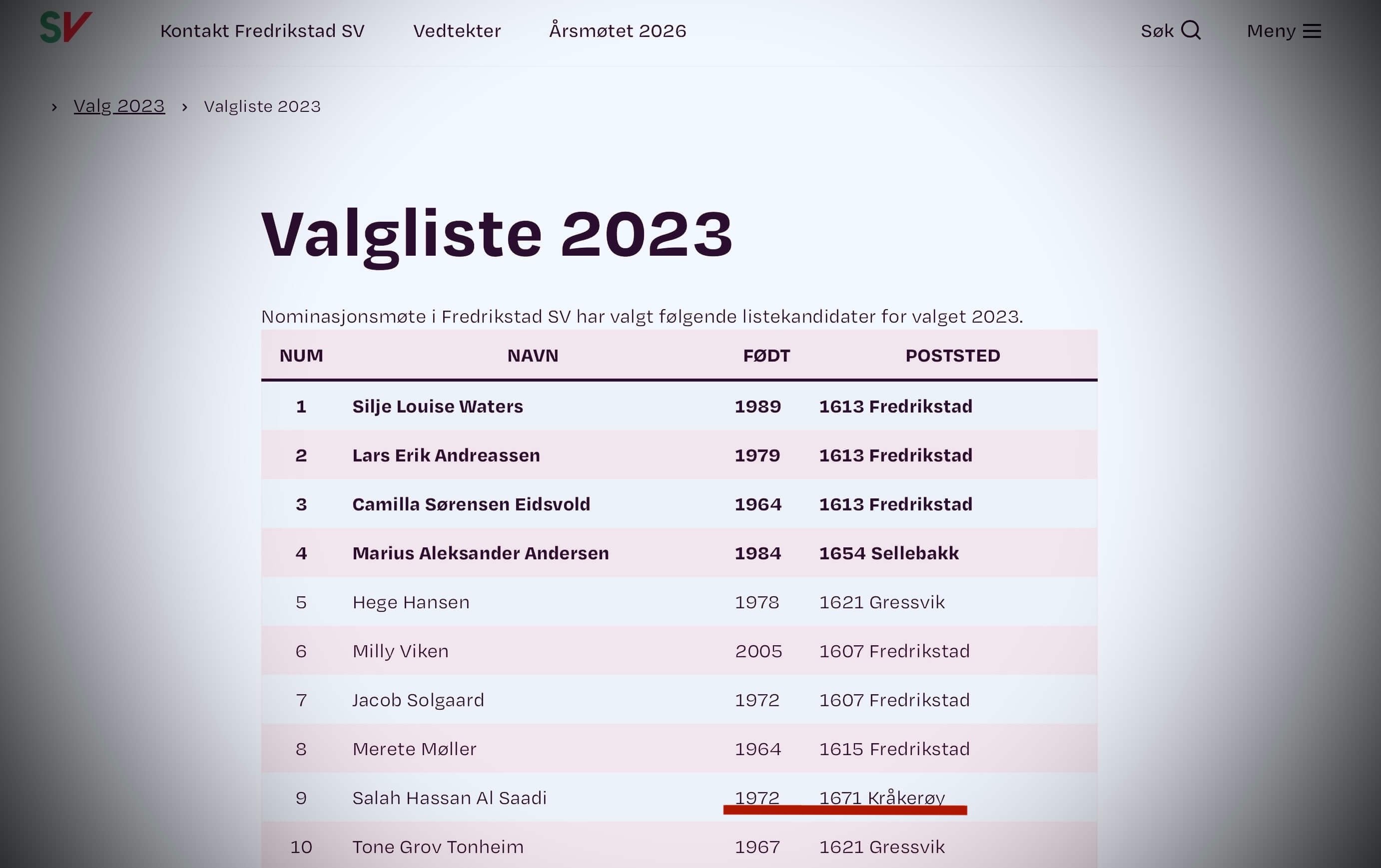
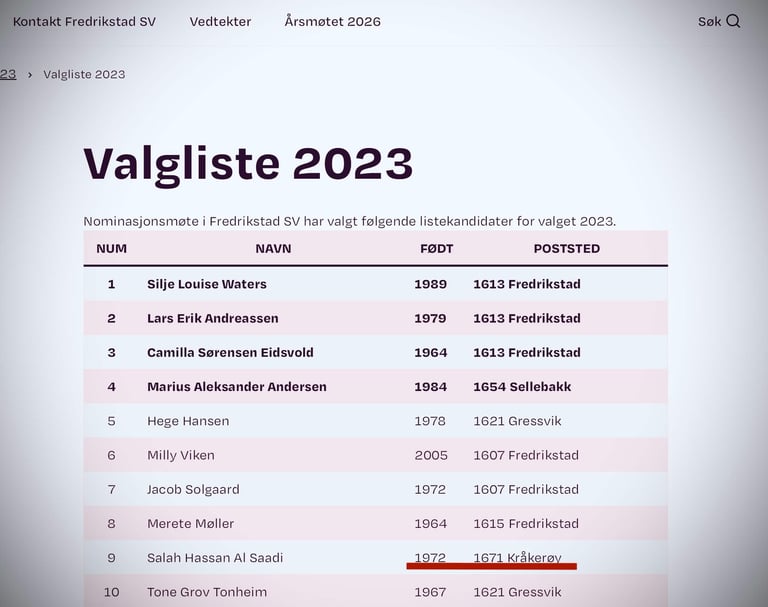
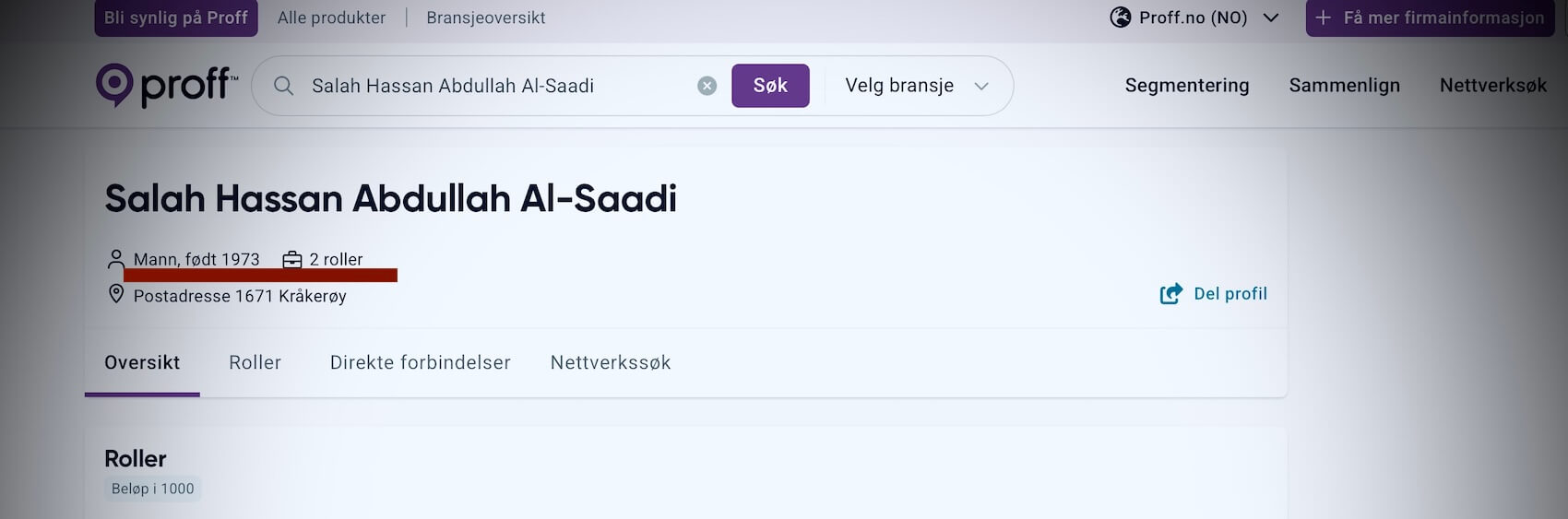

These images reflect a discrepancy in the year of birth as presented in two different sources: the party’s 2023 candidate list and registry data related to individuals. Both sources are publicly available, and the information shown falls within open data accessible without restriction. This discrepancy is presented here as it appears, based solely on officially published information.
A Structured Pattern, Not Isolated Conduct
What emerges is not a series of disconnected acts, but an integrated operational model built on a clear and reproducible structure:
Systematic deception to establish legal status
Use of complaints as instruments of pressure and harm
Leveraging institutional relationships to consolidate influence
Exploiting victims as a means of sustained control
Reproducing narratives whenever exposed
This is not a past that spiraled out of control.
It is a pattern that was deliberately operated, repeatedly executed, and continuously adapted.
Most critically:
it did not cease when exposed,
it reconfigured itself and continued to operate from within the system itself.


In 2022, following the exposure of documents linked to human smuggling operations, the coordinator moved into the residence of a police officer in Oslo a move that is difficult to interpret as personal, but rather as a direct penetration into law enforcement environments.
One year later, in 2023, her partner advanced in parallel into the political structure by running as a candidate for the Socialist Left Party and entering the municipal council in Fredrikstad.
Taken together, these actions do not appear as isolated events, but as part of a pattern of strategic repositioning a gradual shift toward positions that provide access, protection, and the ability to influence the framework of accountability.
Salah Hassan Al Saadi, Qutrnada Adnan Abdulhusin
In light of the facts presented, these actions cannot be treated as isolated incidents or personal disputes, but rather as a recurring pattern of conduct intersecting with explicit criminal provisions under Norwegian law where repetition, structure, and intent converge toward influence, harm, and the avoidance of accountability.
This characterization gains further gravity given that the individual is a candidate for the Socialist Left Party (SV) who, according to available information, revised his résumé in 2023 in a context that coincided with the emergence of evidence and its submission to the Ministry of Justice and Public Security.
This dual dynamic is not incidental:
the reconstruction of public identity on one side, and the activation of legal processes against others on the other.
At this point, the question moves beyond the acts themselves:
How do practices based on false reporting and misrepresentation pass through formal channels, become recorded as legal matters, and then repeat without interruption?
Where does legitimate legal right end, and its exploitation begin?
And at what point does the law shift from a mechanism of protection to a tool for constructing an alternative reality?
If these actions are supported by documentation, records, and testimony,
why do they not result in accountability?
Is it a question of evidentiary threshold?
Or of conduct operating within formal boundaries that shield it?
Or of a system that allows the same practices to be reintroduced in different procedural forms?
The question is no longer what happened
but how the law can be used to protect what it is meant to expose.


Using the Police as a Tool of Harm / False Reports and Deception
The documented facts indicate a recurring pattern of:
filing false police reports
escalating personal disputes into criminal cases
using associated witnesses to reinforce unsubstantiated narratives
This conduct falls within the scope of:
Straffeloven §221 – Providing False Information to Authorities
Applies where misleading or false information is submitted to police authorities in a manner capable of influencing official procedures.Straffeloven §223 – False Accusations
Applies where an individual falsely accuses another of a criminal act with intent to cause harm or initiate legal consequences.Straffeloven §224 – False Reports (Falsk anmeldelse)
Directly applicable to filing police complaints regarding crimes that did not occur or falsely attributing them to others.Straffeloven §225 – Abuse of Legal Process
Relevant where legal procedures are deliberately used to inflict unjustified harm or pressure through formal mechanisms.Straffeloven §263 – Threats
Applicable to documented incidents involving threats with a weapon (knife).Straffeloven §351 – Damage to Property (including arson-related acts)
Applicable to intentional destruction of property, including setting fire to one’s own vehicle for fraudulent purposes.
When such acts are repeated and interconnected, they are no longer treated as isolated misconduct, but align with a recognized pattern in criminological analysis:
the weaponization of legal systems as instruments of coercion and harm.
Second: Financial Fraud and Exploitation of Public Systems
The conduct relating to:
insurance-related incidents
exploitation of NAV welfare programs
submission of misleading information to obtain financial benefits
falls within the scope of:
Straffeloven §371 – Fraud
Covers obtaining financial benefit through deception or misleading conduct.Straffeloven §372 – Aggravated Fraud
Applies where fraud involves repetition, planning, or abuse of trust.Straffeloven §324 – Embezzlement (Underslag)
Applicable where funds received are unlawfully retained or appropriated, particularly in cases classified by authorities as embezzlement-related misconduct.Folketrygdloven – Misuse of Public Benefits
Governs unlawful acquisition or retention of welfare benefits.
In this context, the classification of the case as involving embezzlement by the police, combined with the factual basis of misleading information and financial gain, places the conduct within overlapping legal categories of fraud and financial misconduct, rather than isolated administrative error.
Third: Human Smuggling and Facilitation of Illegal Entry
With regard to acts related to human smuggling:
Straffeloven §257 – Human Smuggling
Criminalizes facilitating unlawful entry into the country.Straffeloven §258 – Aggravated Human Smuggling
Applies where the conduct involves organization, multiple individuals, or exploitation.Utlendingsloven §108 – Immigration Violations and Misleading Information
Applies to providing false information or facilitating illegal entry within immigration procedures.Straffeloven §266 – Coercion / Improper Pressure
Relevant in cases involving threats, control, or pressure applied to smuggled individuals after entry.
These elements entry facilitation, post-entry pressure, document retention, and threats form a continuous operational chain, not separate acts.
Fourth: Reconstruction of Identity as Behavioral Strategy
The reconstruction of the candidate’s public profile in 2023, following the emergence of evidence, does not in itself constitute a criminal offense.
However, within the documented context, it functions as:
a strategic repositioning under legal pressure
an attempt to separate public identity from documented conduct
a mechanism for narrative control within institutional frameworks
This is analytically consistent with post-exposure behavioral adaptation, not a standalone legal violation.
Fifth: The Composite Pattern / When Actions Converge
When the documented acts are assessed collectively:
false reporting and fabricated accusations
threats and coercive conduct
financial fraud and embezzlement-related activity
human smuggling and post-entry exploitation
manipulation of institutional processes
what emerges is not irregular conduct, but a coherent operational pattern in which:
law is used as an instrument
institutions function as a medium
narratives operate as protective structures
Conclusion
Within this framework, the repeated use of police and legal mechanisms to initiate false proceedings, combined with deception, coercion, and financial gain, falls within multiple provisions of Norwegian criminal law.
The convergence of:
fraud and financial misconduct
false reporting and procedural abuse
organized facilitation of illegal entry
coercive control over individuals
indicates not isolated violations, but a pattern consistent with systematic exploitation of legal and institutional frameworks.
If the facts are stripped of their details, one picture remains: an organized network that manipulated the system in Norway for more than seventeen years, drained its institutions and resources, and turned it into a tool for personal revenge and the settling of personal accounts in service of its own interests, and then emerged without accountability. What collapsed in court did not bring it down.
FilesSOSZainab Abdulkarim