Fredrikstad Municipal Council Candidate: Following the Revelation of Conflicting Birth Years, What Did the Norwegian Authorities Say and What Did They Not Say?
Fredrikstad Files IV
Report by a Journalist in Norway 2026
Documented event in Fredrikstad, Norway
In the previous report published on Filessos.com, an apparent discrepancy concerning the birth year of a candidate from the Socialist Left Party (SV) in the 2023 election was documented. The candidate also serves as a deputy member of the Fredrikstad Municipal Council for the 2023–2027 term.
While the official election lists for Fredrikstad Municipality showed that the candidate was registered with the birth year 1972, other public records related to business and company information for individuals in Norway indicated a different birth year: 1973.
The question raised from the very beginning was simple:
How could this discrepancy pass through the election authorities’ verification system without a clear explanation?
Following the publication of the initial investigation, formal inquiries and complaints were submitted to the National Election Board, the Ministry of Local Government and Regional Development, and Fredrikstad Municipality.
The responses arrived.
However, a direct answer to the central question is still pending.
National Election Board: We Are Not the Appropriate Authority
In its official response dated 7 May 2026, the National Election Board did not address the issue of conflicting personal information, either directly or indirectly.
Instead, it focused exclusively on the question of legal jurisdiction.
The National Election Board confirmed that the 2023 municipal election was governed by the previous Election Act, and that the Board, in its current form, only obtained the authority to process election complaints after the new Election Act entered into force in 2024.
On this basis, the complaint was forwarded to the Ministry of Local Government and Regional Development as the competent authority under the regulations that applied during the 2023 election.
The conclusion was clear:
The Board did not investigate the factual circumstances.
It did not reject them.
Nor did it confirm them.
It merely declared that it lacked the jurisdiction to process the case.
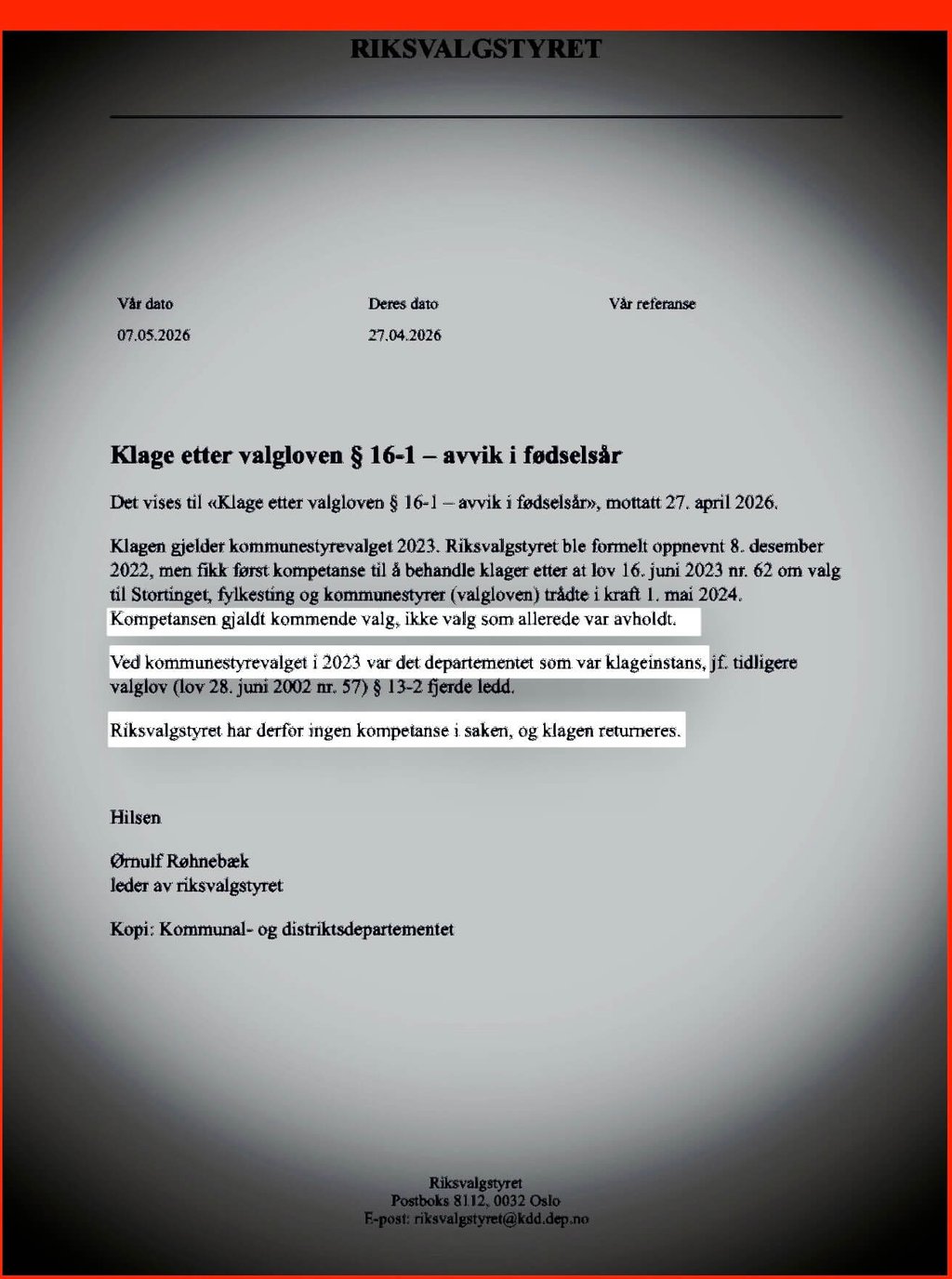
The National Election Board’s response of 7 May 2026 regarding its lack of jurisdiction to process the complaint related to the 2023 election.
Ministry of Local Government and Regional Development: Procedural Closure of the Case
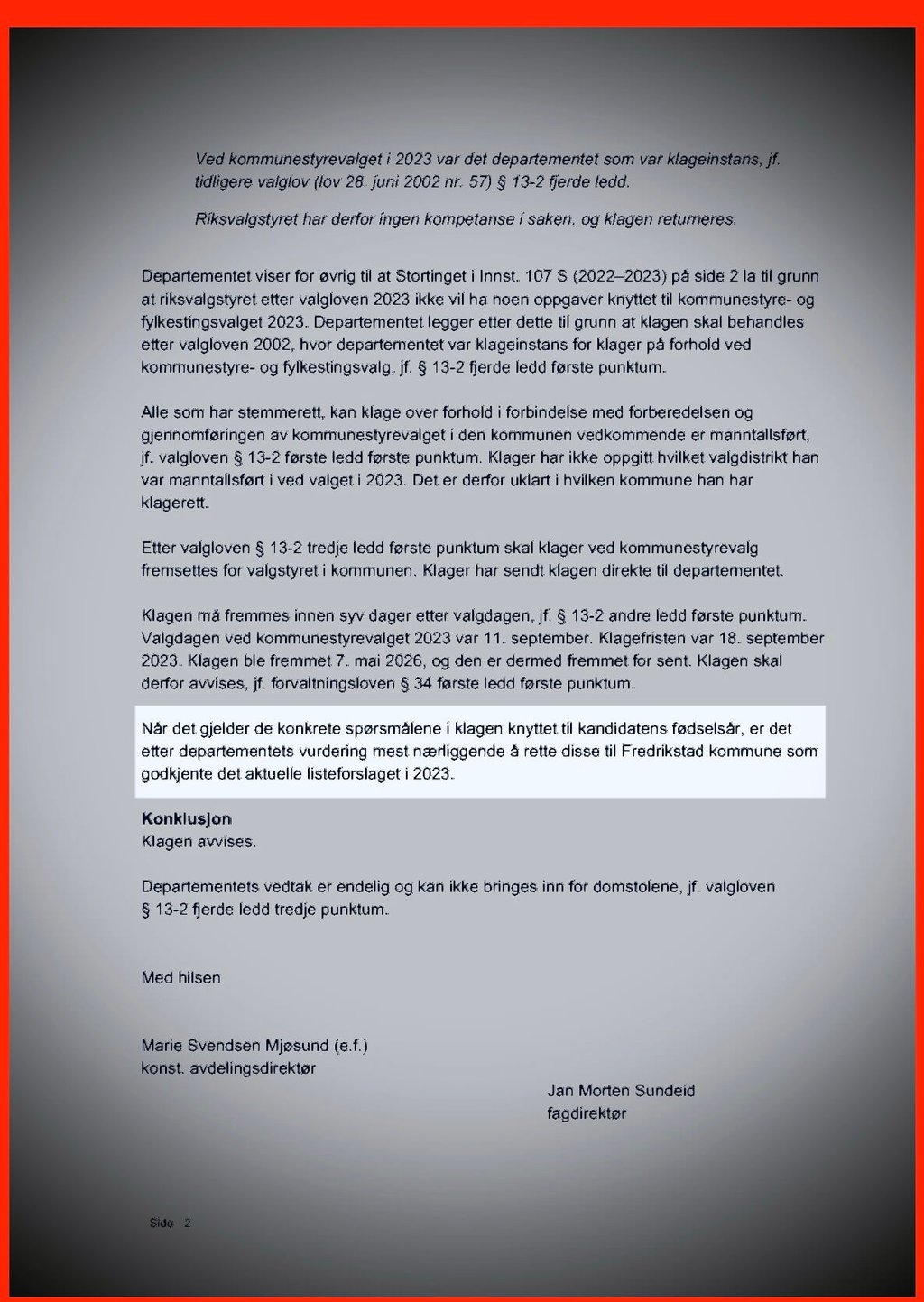
In its decision dated 26 May 2026, the Ministry focused on the procedural aspects of the complaint.
As a first step, it appeared to us that the Ministry handled the case through what may be described as a “purely procedural killing of the case.” Instead of examining the question raised by the official documents that a person is registered in the Fredrikstad Municipal Council with conflicting information, the decision shifted its focus to the right to appeal (Klagerett) and the formal conditions attached to it, an approach that often leads to cases being closed before their core issues are reached.
The Ministry then moved on to the decisive point in its decision: the statutory deadline.
Under the Election Act that was in force in 2023, a complaint had to be submitted within seven days after election day. The complaint in question, however, was filed several years after that deadline had expired, and on this basis the Ministry decided to reject the complaint on formal grounds.
What is noteworthy is that the Ministry did not discuss the actual cause of the contradiction in the information, nor did it provide any explanation for it. Nor did it deny that the contradiction existed. Instead, the Ministry limited itself to closing the case on procedural grounds.
At the same time, the Ministry clarified in its concluding remarks that questions relating to the candidate’s information itself should be directed to Fredrikstad Municipality, which approved the electoral list in 2023.
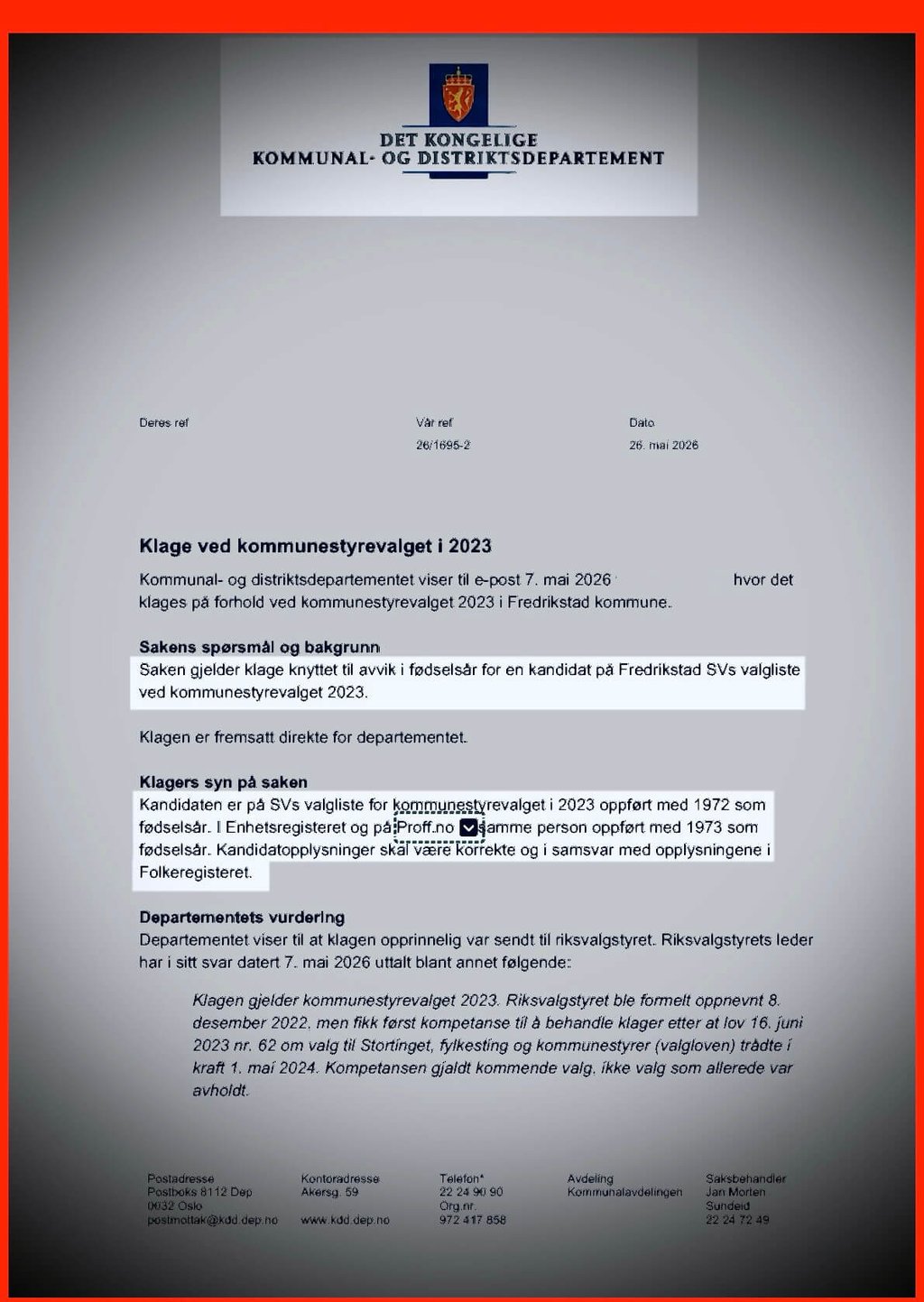
The Ministry of Local Government and Regional Development’s response of 26 May 2026 regarding the complaint concerning a discrepancy in the birth year listed for a candidate in the 2023 municipal election in Fredrikstad.
Fredrikstad Municipality: The First Official Explanation
The Municipality’s response was the most significant in the entire case.
The Municipality confirmed that all candidates were checked against the National Population Register during the approval of the electoral lists.
It also confirmed that the information concerning the candidate in question had been verified in accordance with the applicable routines and procedures.
However, when the Municipality was asked why a different birth year appears in other public registers, the response took a completely different form.
In the official reply, signed by Special Adviser Dick Ekeroth, it states:
“This may possibly be explained by the fact that the candidate has been assigned a new personal identification number after the individual was checked.”
That is to say:
“This may possibly be explained by the candidate having received a new personal identification number after the verification was carried out.”
This wording represents the first official explanation that has emerged in the case since it began.
At the same time, it does not constitute a confirmation of a concrete fact.
The Municipality has not confirmed that the candidate actually received a new personal identification number.
Nor has it stated whether it has verified this.
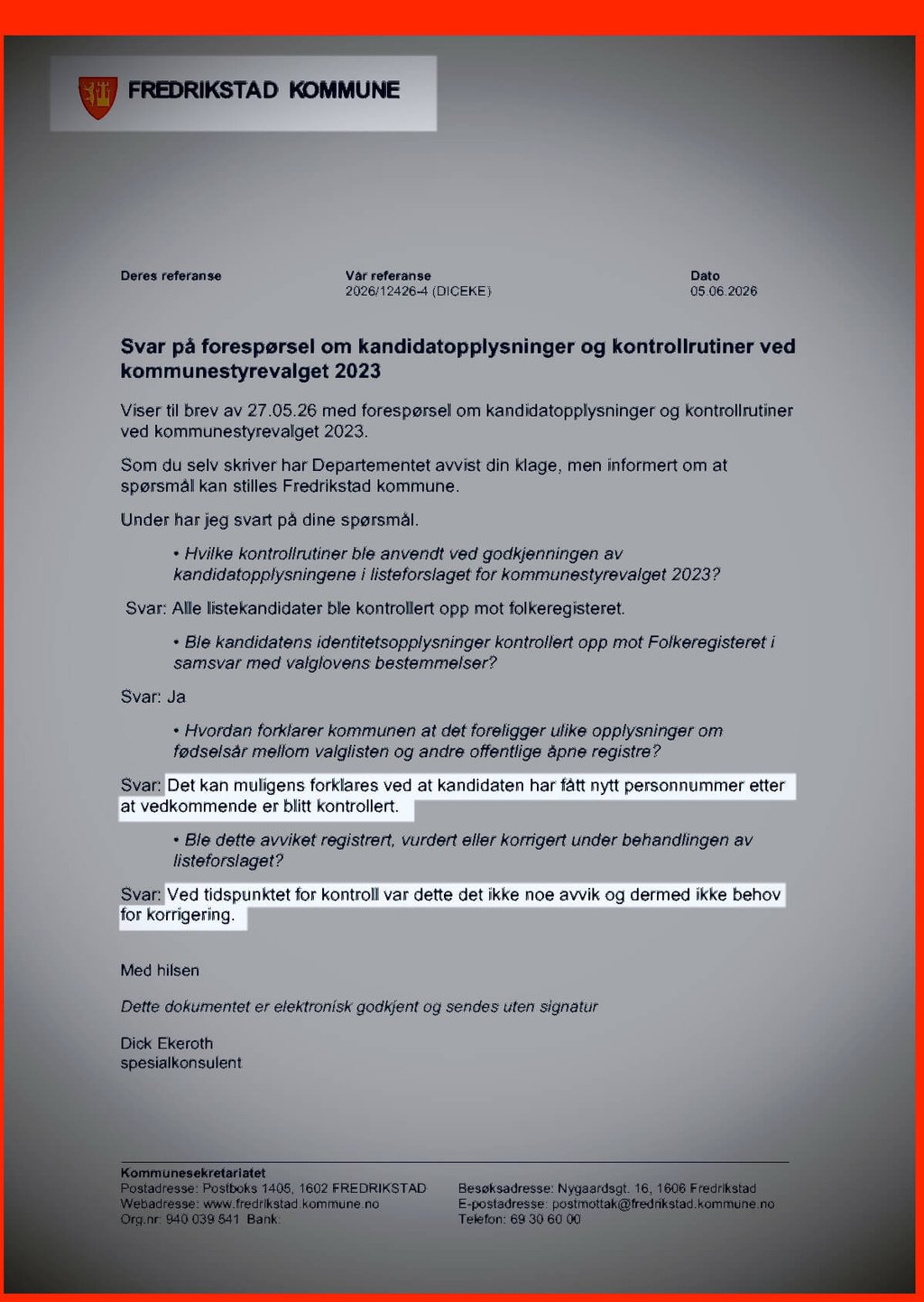
Response from Fredrikstad Municipality dated 5 June 2026 regarding the verification of candidate information and the Municipality’s explanation for the discrepancy in the birth year in the 2023 municipal election.
Deconstruction of the Hypothesis of “a New Personal Identification Number”
We cannot be satisfied with merely relaying Fredrikstad Municipality’s explanation without subjecting it to scrutiny and analysis.
The only explanation the Municipality has provided to justify the contradiction between the birth year in the electoral list and other public registers is that the candidate “may have received a new personal identification number” after his information was checked.
But this hypothesis raises more questions than it provides answers.
First: A Personal Identification Number in Norway Is Not an Ordinary Number
For a reader outside Norway, it may appear that this is an administrative number that can easily be replaced.
But the reality is entirely different.
The Norwegian personal identification number (Fødselsnummer) constitutes the backbone of a person's legal and administrative identity within the state. It is the key to which tax information, social security information, banks, companies, ownership records, insurance records, and other public databases are linked.
For this reason, changing a personal identification number is neither a routine nor a common procedure. On the contrary, it is regarded as one of the most sensitive and complex administrative processes within the Norwegian National Population Register system.
Second: When Does a Person Receive a New Number?
Under normal circumstances, a person retains their personal identification number throughout their life.
The assignment of a new number, or a change in the fundamental information linked to it, is usually associated with highly extraordinary circumstances, such as the correction of a significant error in the original identity following extensive official reviews, or in cases involving strict security protection imposed by the authorities for individuals exposed to an extraordinary risk.
The person we are referring to here is far removed from this logic and these circumstances, in light of a documented criminal past and cases involving embezzlement, fraud, and malicious conduct.
A legitimate question therefore arises:
Was the Municipality relying on actual information indicating that such a change had taken place?
Or was this nothing more than a hypothetical possibility put forward to explain the existing contradiction?
The official response provides no answer to this.
Third: Where Are the Traces of This Change? (A Hypothesis That Has Been Technically Refuted)
Even if, for the sake of argument, we were to accept the Municipality’s hypothesis that the candidate has received a new personal identification number, it is obvious that this would leave traces in state registers. Reality, however, shows that active public and commercial registers still identify him with the birth year 1973 as his only identity.
This contradiction confirms that the Municipality’s explanation was not a documented fact, but merely a possibility and a formulation that was quickly put together to fill an administrative vacuum. The Municipality did not state that it had investigated the matter or summoned the candidate himself, despite the fact that he is not an unknown person, but sits on the Municipal Council.
This hypothesis collapses completely when confronted with the technical facts available to the public: if the change actually took place, where are its traces in the state’s registers?
The Municipality and the voters have the right to know the real identity of the person who sits on the Municipal Council. Settling for the word “perhaps” may give the impression of a clear avoidance of confronting the reality that the electoral system may have been carried out using inaccurate information.
Perhaps the purpose was to get through the background-check procedures.
What Did the Ministry of Local Government and Regional Development Say Just a Few Weeks Ago?
What is remarkable in this case is that the Ministry of Local Government and Regional Development, in initial correspondence documented electronically and dated 17 April 2026, through its legal adviser Hilde Greve Mo, had provided a detailed explanation of how information concerning candidates is checked before electoral lists are approved.
At that time, the Ministry confirmed that the election authorities do not approve any candidate unless the candidate’s information corresponds with the information registered in the National Population Register. The Ministry also explained that any error in a date of birth or in basic personal information requires that the representatives of the list be contacted and given a deadline to correct the information before the final list is approved.
The Ministry’s response stated that a candidate cannot be approved if the information does not correspond with the information in the electoral register, which is primarily based on information from the official National Population Register.
The Ministry further pointed out that errors in information concerning a candidate on the ballot paper (Feil på stemmeseddelen) may constitute grounds for a complaint under Section 16-1 of the Election Act, and that such errors may have legal significance if they have affected the election result or the allocation of seats.
But when the issue moved from the theoretical legal framework to the practical case concerning a candidate for the Fredrikstad Municipal Council, the Ministry’s final decision of 26 May 2026 did not address these fundamental points.
Instead of discussing how the information had been checked or explaining the contradiction between the birth year appearing on the electoral list and the birth year appearing in other public registers, the decision limited itself to questions of jurisdiction, the statutory deadline, and the right to submit a complaint.
From a purely procedural perspective, this was sufficient to close the case.
From a substantive perspective, however, the central question remained unanswered:
If correspondence between candidates’ information and the National Population Register is a legal requirement before electoral lists can be approved, and if Fredrikstad Municipality confirms that this check was in fact carried out, how could electoral information be approved and registered when it later turned out to differ from the official information appearing in other public registers?
How did this information pass through all stages of control and review without being discovered or corrected before the list was approved?
And if this information was correct and corresponding at the time of registration, as Fredrikstad Municipality confirms, why do other official registers that are still in use by the state show a different birth year to this day, while the electoral lists of Fredrikstad Municipality remain the only exception containing differing information?
What Do We Know Today About One of the Candidates for Fredrikstad Municipality?
Regardless of the controversy surrounding the candidate, and regardless of the cases, judgments, documents, and witness statements that have described a criminal past marked by manipulation, serious malicious litigation, extortion, and fraud over several decades in multiple cities and regions from Chicago to Norway, the issue raised here is not an assessment of his person or his history, but a more important institutional question: How was electoral information approved when it differs from information appearing in other public registers, despite the fact that the law requires verification of correspondence with the National Population Register before a candidacy is approved?
We know that there is an apparent contradiction between the birth year listed on the electoral list and the birth year appearing in other public registers.
We know that Fredrikstad Municipality confirms that it carried out verification and correspondence assessment against the National Population Register.
We know that the Ministry of Local Government and Regional Development confirmed that the approval of candidates must be based on information corresponding with the National Population Register.
We know that the national election authority declared that it did not have jurisdiction to deal with the 2023 election.
We know that the leader of the Socialist Left Party (SV) in Fredrikstad, Emilie Østby, was contacted as part of a journalistic inquiry concerning the case, but that she declined to answer the questions that were asked and ended the telephone conversation in a manner that appeared tense, without providing any explanation regarding the matters that were raised.
We know that in 2023, before the election, warnings and reports of concern regarding the candidate’s criminal background were submitted to several bodies, including Fredrikstad Municipality, the Socialist Left Party (SV), and other national authorities, without this leading to any publicly disclosed review of the candidate’s situation or of the information that later became the subject of questions.
But what we still do not know is the most important element in the entire case:
If correspondence between candidates’ information and the National Population Register is a legal requirement before electoral lists can be approved, and if the Municipality confirms that this check was in fact carried out, how could electoral information be approved and registered when it later turned out to differ from the official information appearing in other public registers?
If the administrative rules give public authorities the right to reject complaints after the expiry of statutory deadlines, questions concerning the accuracy of public registers and electoral registers are not resolved merely by the passage of time.
The possibility of filing a complaint may be closed as a result of procedural deadlines, but the question itself remains open:
How was this information approved? And who bears responsibility for this contradiction if it turns out that the published electoral information was not in accordance with the official information upon which the state itself relied in its other registers?
Does the responsibility lie with the candidate?
Or with the party that submitted the list?
Or with the control system that was supposed to detect any contradiction before the candidacy was approved?
This is the question that still remains unanswered.


FilesSOSZainab Abdulkarim