From Oslo to Gulating: The Fall of a Litigative Strategy Based on more than 27 Failed Cases

Zainab Abdulkarim - Art, Vest politidistrikt, Gulating lagmannsrett, Rettsavgjørelse, Oslo politidistrikt, Salah Al Saadi

Reported by a journalist in Norway, March 2026

Documented event in Western Norway

How Western Norway’s Police and Courts Dismantled the Legal Arsenal of Zainab Abdulkarim Ali and Her Network After More Than 27 Malicious Cases, Breaking a Shield of Protection and Favoritism Provided by the Oslo Police.

Oslo – March 2026

In the world of organized crime and procedural circumvention, investigators rarely encounter a mindset that combines cunning with the manipulation of state institutions to serve its own purposes in the way that "Zainab Abdulkarim Ali" managed her activities for years. Zainab was not merely a party to a passing dispute; rather, according to the case files, she was the mastermind behind a complex criminal deception strategy that lasted for nearly two decades, using Norwegian law as a "weapon of oppression" to silence witnesses and suppress facts documenting the suspicious activities of the cross-border migrant smuggling network linked to her.

However, the final stage in March 2026 was unlike any other; this mindset collided with the formidable judicial wall of the police and courts of Western Norway, causing the collapse of a historic scheme in which state resources in the city of Fredrikstad and Oslo were expended through more than 27 malicious criminal cases that began in 2010 and ended in March 2026.

Engineering Influence: Constructing Immunity and Penetrating Oslo Police

To accurately understand the operating mechanism of this network, it is necessary to return to the recurring pattern extending back to 2008, when the plaintiff demonstrated an ability to identify administrative loopholes within the security apparatus in order to impose silence on witnesses through the construction of parallel complaint records. In 2022, this cunning reached its peak through direct penetration into the Oslo Police environment, exploiting a close personal relationship with a police officer and residing in his home, thereby establishing for herself an "undeclared shield of protection."

This protection was not merely personal; it evolved into an institutional cover. The plaintiff became protected by the influence of her officer, while Oslo Police directorates and departments united and the legal system was harnessed in favor of her interests and the interests of her network with the Majorstuen Police Station serving as the central point of support in a unified front backing her narrative and allegations. "Internal recommendations" and memoranda drafted and prepared by lawyers and prosecutors within Oslo Police were circulated through desperate and objectionable methods aimed at securing a single procedural victory that would protect the network at the expense of the evidence, thereby insulating her file and the network's file from scrutiny and reducing suspicion surrounding them. Documents and sources explicitly indicate that this influence developed into direct manipulation of legal processes, including cooperation with Oslo Police prosecutor Maren Britt Østern to obtain unlawful documents and correspondence lacking any factual basis in order to support the plaintiff and her network against witnesses [Document No.: 15698618 16998/22-201/MBO035, dated 18 May 2022].

The Silenced Scandal: Defying Judicial Overseers and the Subversion of Law

The absolute climax of this institutional subversion lies in a damning chronological defiance of the law: the very documents and communications "cooked up" internally by Oslo police lawyers had already been officially and unequivocally branded a "grave official error" (Tjenestefeil). This explosive condemnation was handed down in a classified ruling by the Norwegian Bureau for the Investigation of Police Affairs (Spesialenheten) on May 10, 2022.

Yet, in a staggering display of institutional arrogance and systemic corruption, those implicated within the Oslo Police chose to operate entirely above the law. Rather than halting their unlawful track, they aggressively pushed forward, weaponizing these legally void documents before the Oslo District Court. This desperate gamble to force a judicial fait accompli backfired catastrophically just weeks later, culminating in a resounding legal defeat on May 30, 2022.

Confronted with both an internal condemnation from their highest oversight body and a crushing defeat in open court, the details of this dual failure were immediately shrouded in strict secrecy within the corridors of the "Majorstuen" department. This administrative blackout was a calculated maneuver to suppress a massive institutional scandal that threatened to shatter the reputation of the capital’s police force, especially after the direct, corrupt involvement of the briefed officer, influential investigators, and Prosecutor "Østern" was fully established.

The conspiracy did not stop at concealment. To insulate themselves from further exposure, strict internal procedural orders were issued, completely banning the department from any future interaction with the witness effectively admitting that their institutional credibility had been entirely compromised. However, this internal quarantine provided the plaintiff with the ultimate rogue shield. For years, she was permitted to recycle these legally defunct papers in other jurisdictions, using them as a tool of coercion to target witnesses and launch malicious, fabricated accusations, heavily backed by complicit insiders.

This entrenched network inside Oslo successfully suppressed exposure for years, until it collided directly with the integrity of the Western Police District (Vest politidistrikt) and the authorities of the Western Norway region (Vestlandet) in 2025. In a frantic bid to protect the plaintiff and her syndicate, capital officials definitively blocked Western authorities from seizing the investigation file. This blatant obstruction choked a severe, document-backed transnational investigation into human trafficking and the smuggling of irregular migrants into the Schengen zone. This systematic pattern mirrors the dark realities of the infamous Eirik Jensen case, demonstrating once again how the boundaries between official public service and organized criminal networks dissolve when mutual protection becomes the law of the land.

March 2026 Maneuver: Circumventing the January Ruling and the Logic of “Digital Censorship”

On January 19, 2026, the network and the Oslo police received a judicial slap in the face with the issuance of a preliminary ruling by the Sogn og Fjordane District Court (Sogn og Fjordane tingrett), in which the plaintiff and her backers from the Oslo police and their female lawyers lost the latest in their series of fabricated cases.

In response to this defeat, on March 9, 2026, the coordinator took her final procedural step within an exposed maneuver executed in coordination with her partner Salah Hassan Al-Saadi, a candidate for the Socialist Left Party (SV) and a deputy member of the Fredrikstad City Council for the 2023–2027 term and Qatranada Adnan Abdulhussein his wife. This alliance launched four coordinated lawsuits: three reports through the police and a delayed judicial appeal in which she falsely and deceitfully claimed she had been unable to receive the January ruling for months, asserting that she received it on March 9, 2026, aiming to circumvent the strict statutory deadlines for appeal (Ankefrist).

In this appeal, the coordinator armed herself with the exact same documentation package prepared by the Oslo police departments previously classified as a "grave official error." Her objective was to pressure the court’s conviction to extract a restraining order (Restraining Order). However, the goal was not security related at all; rather, it represented a desperate and final attempt to enforce coercive digital censorship, compelling platforms to delete the public materials and documents that constitute issues of public and societal importance, which expose the methods of disinformation, smuggling, and the deception of authorities and societies associated with her and the network, and the manipulation of legal systems.

Gulating lagmannsrett, Vest politidistrikt, Bergen vest politistasjon, Oslo politidistrikt, Zainab Abdulkarim-Salah Al Saadi

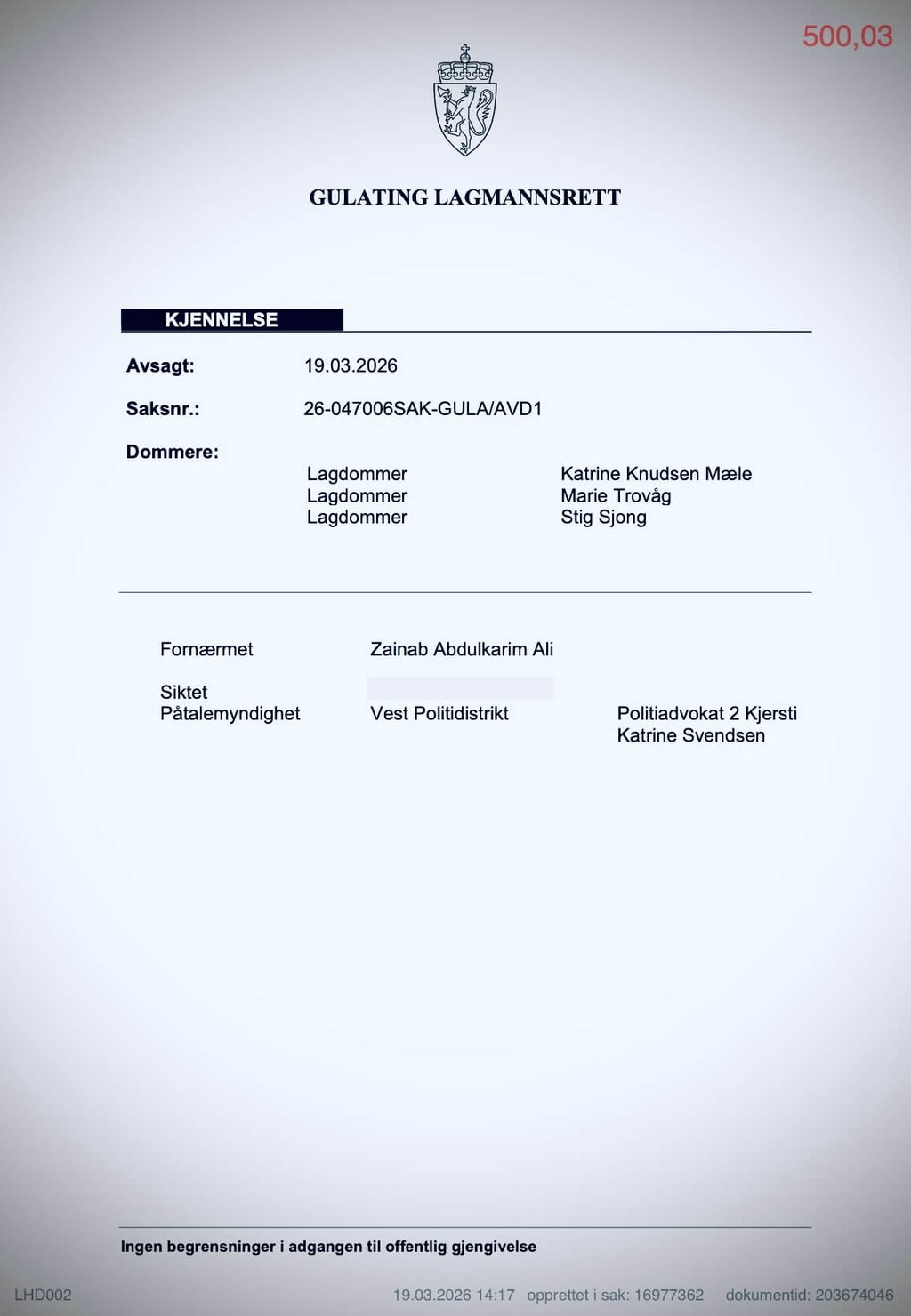
DECISION OF THE GULATING COURT OF APPEAL

19.03.2026

26-047006SAK-GULA/AVD1

THE GULATING COURT OF APPEAL JUDGMENT: THE JUDICIAL FORTRESS AND THE COLLAPSE OF THE DOMINO EFFECT

On 19 March 2026, the Gulating Court of Appeal (Gulating lagmannsrett) delivered its final ruling, dismissing the appeal in its entirety in Case No. [26-047006SAK-GULA/AVD1]. The judgment, together with the accompanying submission from the prosecution authority, systematically dismantled the legal manoeuvres advanced by the appellant.

1. The Western Norway Prosecution Authority: No Compliance with Censorship or Suppression of Freedoms

The prosecution authority in Western Norway acted as a barrier against attempts to use state power to conceal digital evidence, relying on the protection of freedom of expression and the right to publish.

Official court text (Prosecution Authority response):

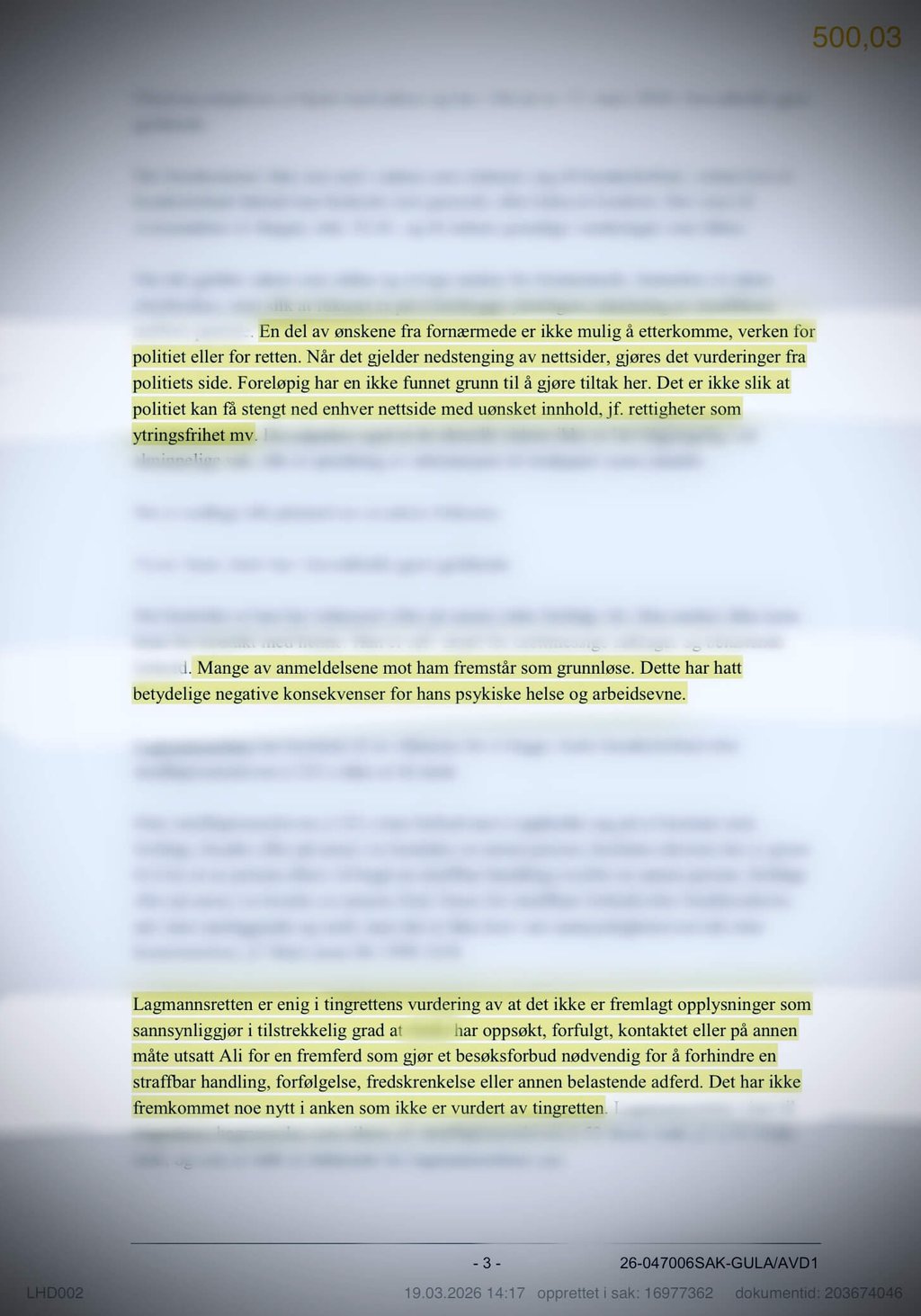
"En del av ønskene fra fornærmede er ikke mulig å etterkomme, verken for politiet eller for retten. Når det gjelder nedstenging av nettsider, gjøres det vurderinger fra politiets side. Foreløpig har en ikke funnet grunn til å gjøre tiltak her. Det er ikke slik at politiet kan få stengt ned enhver nettside med uønsket innhold, jf. rettigheter som ytringsfrihet mv."

English translation:

"Some of the requests made by the complainant cannot be accommodated, either by the police or by the courts. As regards the closure of websites, assessments are made by the police. So far, no grounds have been found for taking any action. The police do not have the authority to shut down any website simply because it contains unwanted content, in light of protected rights such as freedom of expression and related freedoms."

2. Judicial Documentation of Procedural Abuse and Systematic Harassment

For the first time, the courts formally documented the serious and systematic harm resulting from a pattern of unfounded criminal complaints.

Official court text:

"Mange av anmeldelsene mot ham fremstår som grunnløse. Dette har hatt betydelige negative konsekvenser for hans psykiske helse og arbeidsevne."

English translation:

"Many of the complaints filed against him appear to be without foundation. This has had significant negative consequences for his mental health and his ability to work."

3. Complete Absence of Evidence and the Collapse of the Allegations

The appellate judges unanimously concluded that the appeal consisted of unsupported allegations lacking sufficient factual credibility.

Official court text (core finding of the Court):

"Lagmannsretten er enig i tingrettens vurdering av at det ikke er fremlagt opplysninger som sannsynliggjør i tilstrekkelig grad at ##### «redigert / anonymisert». har oppsøkt, forfulgt, kontaktet eller på annen måte utsatt Ali for en fremferd som gjør et besøksforbud nødvendig for å forhindre en straffbar handling, forfølgelse, fredskrenkelse eller annen belastende adferd. Det har ikke fremkommet noe nytt i anken som ikke er vurdert av tingretten."

English translation:

"The Court of Appeal agrees with the District Court's assessment that no information has been presented which sufficiently substantiates that #### “redacted / anonymized” has approached, pursued, contacted, or otherwise subjected Ali to conduct making a restraining order necessary in order to prevent a criminal act, harassment, disturbance of the peace, or other burdensome behaviour. Nothing new has been presented in the appeal that was not already considered by the District Court."

Judicial Conclusion: A Decisive Outcome

By unanimous agreement of all three appellate judges, the prolonged legal campaign was brought to an end in two unequivocal words:

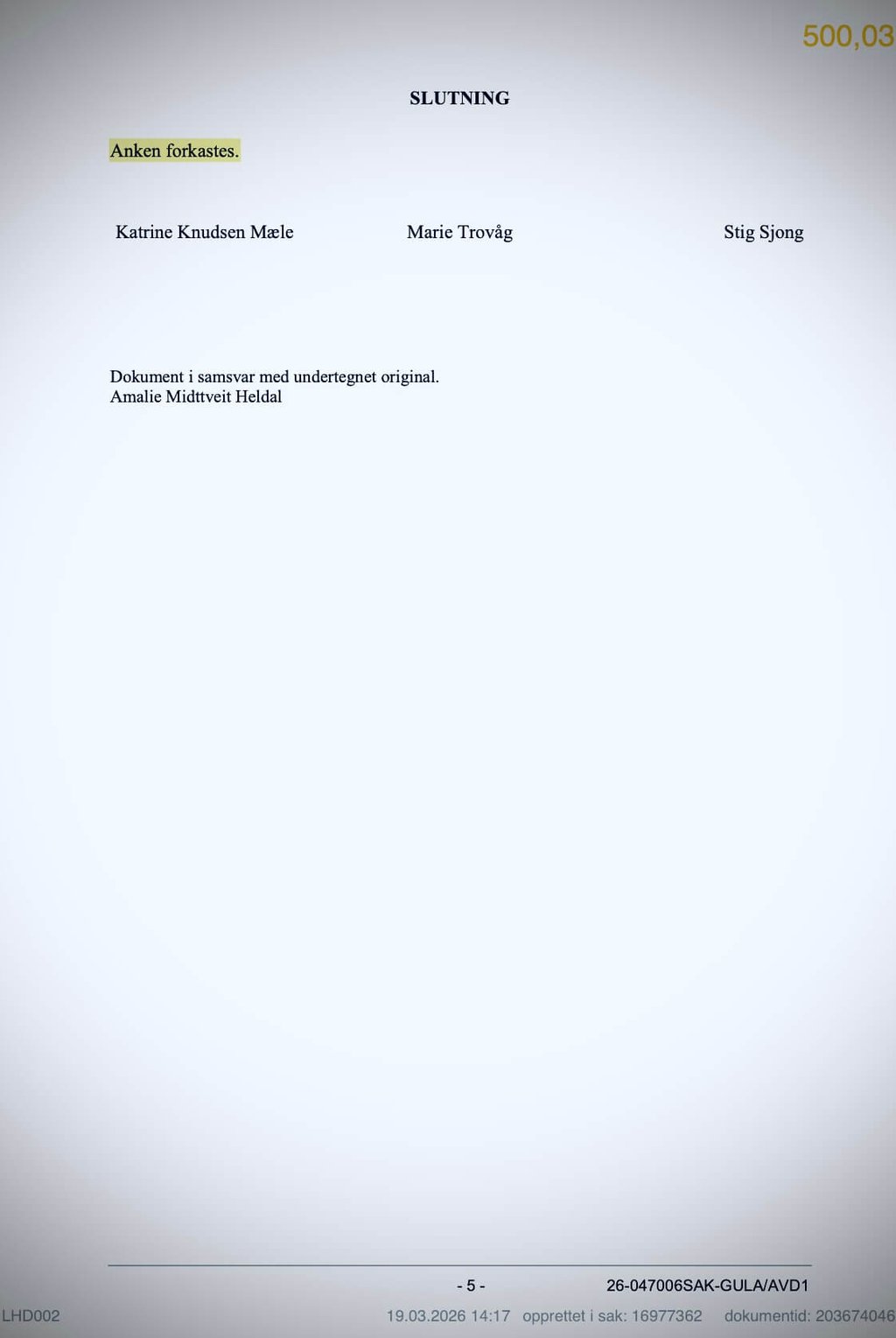
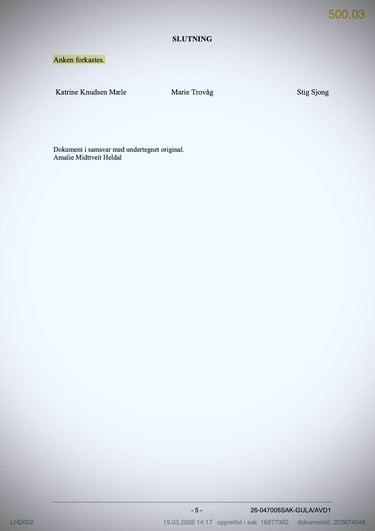
SLUTNING: ANKEN FORKASTES.

Final ruling: "The appeal is dismissed in its entirety."

Investigative Analysis: When Western Norway Drew the Line

This final chapter reveals a broader struggle over institutional integrity and the repeated recycling of misleading narratives.

For years, the network and its leading figures successfully exploited procedural contradictions, pockets of influence, silent complicity, and reciprocal recommendations within both Fredrikstad and Oslo. State institutions in the capital were gradually transformed into platforms serving coordinated legal complaints and providing informal protection for activities linked to migrant smuggling operations, creating systemic disruption and consuming significant public resources.

The turning point came when these methods collided with the institutional resilience of the Western Police District (Vest politidistrikt) and the courts of Western Norway (Vestlandet).

The judicial and law-enforcement institutions of Western Norway demonstrated a high degree of investigative and legal independence. Prosecutors refused to facilitate intimidation or censorship, while the Gulating Court of Appeal declined to give weight to the questionable documents originating from Oslo. By drawing a firm line, the authorities in Western Norway brought a sustained pattern of manipulation and procedural abuse to an end, closing a chapter marked by years of institutional disorder and reaffirming a fundamental principle: attempts to manipulate justice ultimately unravel when subjected to independent judicial scrutiny.

Zainab Abdulkarim Ali, Maren Britt Østern, the Gulating Court of Appeal, Gulating lagmannsrett

GULATING COURT OF APPEAL DECISION – ZAINAB ABDULKARIM ALI CASE

ENGLISH TRANSLATION:

500,03
GULATING COURT OF APPEAL
DECISION

Issued:
Case No.:
Judges:
19.03.2026
26-047006SAK-GULA/AVD1
Appellate Judge, Appellate Judge, Appellate Judge
Katrine Knudsen Mæle
Marie Trovåg
Stig Sjong

Injured Party: Zainab Abdulkarim Ali
Defendant: Vest Police District
Prosecution Authority: Police Prosecutor 2 Kjersti Katrine Svendsen

No restrictions on the right of public disclosure

LHD002
19.03.2026 14:17 created in case: 16977362 document ID: 203674046

Zainab Ali, Vest politidistrikt, Sogndal politidistrikt, Bergen politidistrikt, Florø politi

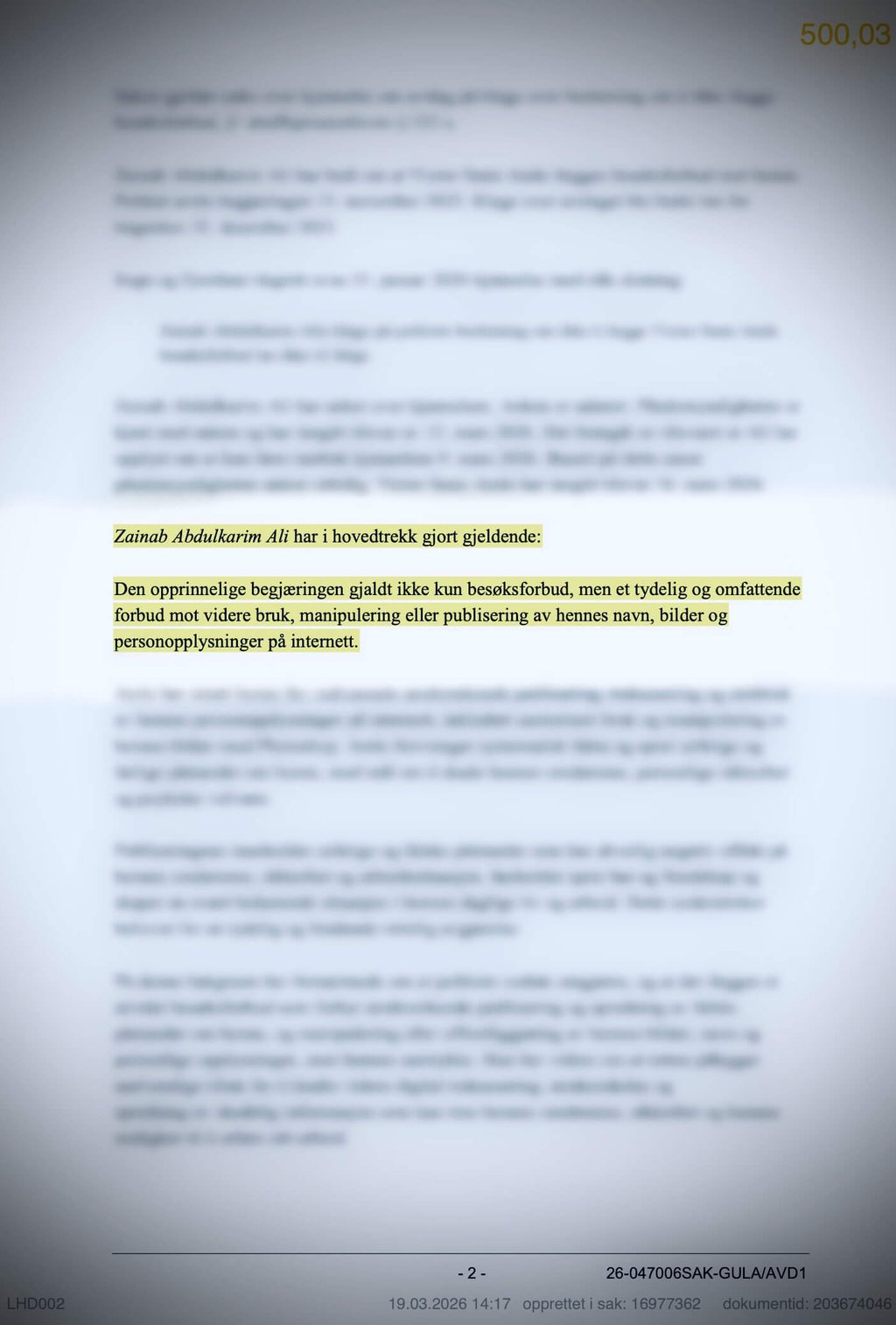
GULATING COURT OF APPEAL DECISION – ZAINAB ABDULKARIM ALI CASE

OFFICIAL COURT TEXT (ZAINAB ABDULKARIM ALI’S STATEMENT):

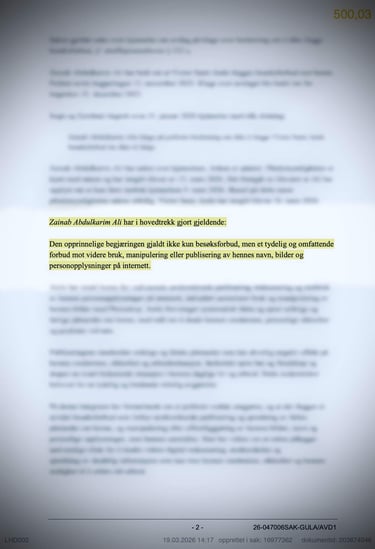
“The original application did not concern a restraining order alone, but also sought a clear and comprehensive prohibition on the continued use, manipulation, or publication of her name, images, and personal data on the Internet.”

Gulating, Sogn og Fjordane tingrett, Vest politi, Sogndal politi, Bergen politi, Florø politi

GULATING COURT OF APPEAL DECISION – ZAINAB ABDULKARIM ALI CASE

OFFICIAL COURT TEXT (PROSECUTION AUTHORITY STATEMENT – WESTERN NORWAY):

“A part of the complainant’s requests cannot be granted, neither by the police nor by the court. As regards the removal or shutdown of websites, such matters are subject to assessment by the police authorities. So far, no grounds have been found to take any such measures. The police do not have the authority to shut down any website merely because it contains unwanted content, in light of protected rights such as freedom of expression and related legal safeguards.”

OFFICIAL COURT TEXT (COURT FINDING ON COMPLAINTS AND IMPACT):

“Many of the complaints against him appear to be without foundation. This has had significant negative consequences for his mental health and his ability to work.”

OFFICIAL COURT TEXT (COURT OF APPEAL FINDING):

“The Court of Appeal agrees with the District Court’s assessment that no information has been presented which sufficiently substantiates that the person in question has approached, pursued, contacted, or in any other manner subjected Ali to conduct that would make a restraining order necessary to prevent a criminal act, harassment, violation of peace, or other burdensome behaviour. No new information has been presented in the appeal that was not already assessed by the District Court.”

Gulating lagmannsrett, Court Decision, Zainab Abdulkarim Ali, Salah Hassan Al Saadi, Italy, Crotone

GULATING COURT OF APPEAL DECISION – ZAINAB ABDULKARIM ALI CASE

OFFICIAL COURT TEXT:

“Accordingly, the appeal shall be dismissed.
The decision is unanimous.”

Zainab Abdulkarim Ali, Oslo, Norway, Gulating lagmannsrett, Oslo Police corruption، Maren B. Østern

GULATING COURT OF APPEAL DECISION – ZAINAB ABDULKARIM ALI CASE

OFFICIAL COURT TEXT:

CONCLUSION

The appeal is dismissed.

Katrine Knudsen Mæle

Marie Trovåg

Stig Sjong

This document corresponds to the signed original.

Amalie Midttveit Heldal

Acknowledgement and Appreciation: The Institutional Divide

In closing this file, the editorial board affirms that this judicial process was not a routine procedural step in a dispute, but a precise examination of the structure of justice when pushed to its outer limits, where facts intersect with allegations and institutions are tested under the pressure of complexity and procedural multiplicity.

This file has ultimately exposed a profound institutional divide, serving as a direct comparative study between two conflicting doctrines of law enforcement within the same state:

  • The Oslo Model of Complicity: On one side, the actions within the capital demonstrated a disturbing subversion of authority, where the Oslo Police allowed public office to be compromised by personal relationships and mutual interests. In Oslo, the legal apparatus was harnessed as a private shield to protect the plaintiff and her network, going so far as to defy oversight bodies and weaponize legally defunct papers to sustain fabricated narratives.

  • The Western Norway Model of Integrity: On the other side, the judicial and law enforcement path taken in Western Norway stood as a definitive rejection of this institutional decay. Western authorities demonstrated a textbook example of institutional capacity and unyielding integrity, refusing to bend to external pressures, silent complicity, or capital influence.

Consequently, Western Norway managed this highly sensitive matter within a strict procedural legal framework, with a clear and consistent commitment to distinguishing suspicion from evidence, and allegation from what is substantiated in the evidentiary record. This was reflected in the gradual progression from the regional police level (Vest politidistrikt – Western Police District, including Sogndal, Florø and Bergen Police Station / Sogndal politistasjon, Florø politistasjon, Bergen politistasjon) to the court of first instance (Sogn og Fjordane tingrett), and ultimately to the Court of Appeal (Gulating lagmannsrett), where the decisive standard remained anchored in objective facts rather than personal perception or tailored interpretation.

What has been achieved in this context should not be read as a position or an alignment, but as an expression of the function of the legal state in maintaining its internal equilibrium under pressure, and preserving the primacy of procedure over any attempt to reconstruct truth outside its official evidentiary mechanisms.

In this sense, this acknowledgement is not a tribute to a specific entity, but a formal record of an institutional standard that asserted itself at a moment when legal precision stood as the final line of defense against systemic manipulation, securing the coherence of justice as a whole.